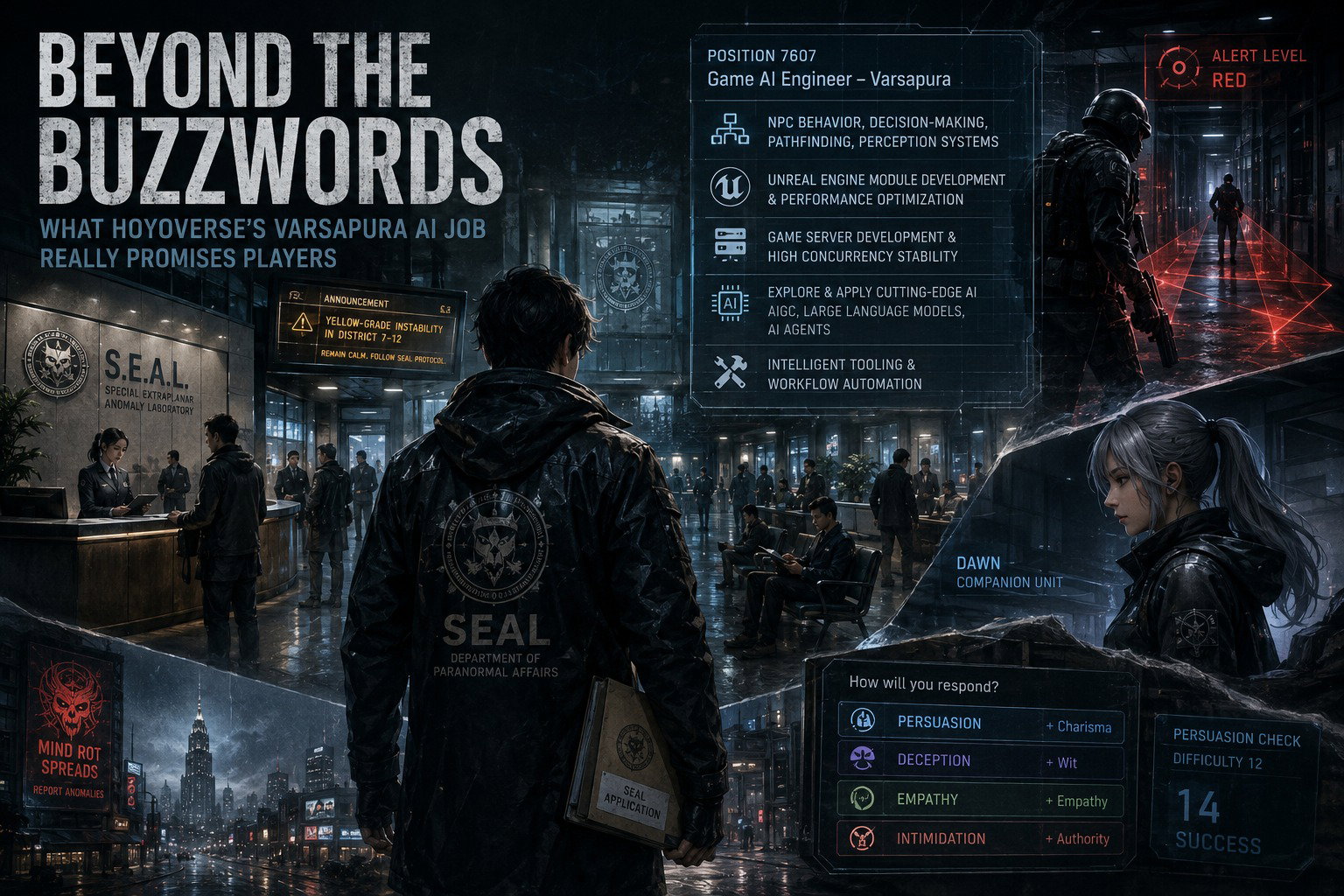
Inside HoYoverse's Varsapura AI Engineer Job Posting: What It Quietly Promises Players
Most HoYoverse hiring pages are wallpaper. Position 7607 on the Mandarin-facing miHoYo careers portal — mirrored in English as Game AI Engineer – Varsapura on the company’s Singapore Greenhouse board, with a junior counterpart covering the same surface area — is the rare exception. Cross-referenced against the 31-minute reveal and the AI features the demo already put on screen, the listing reads almost like a redacted feature checklist. The keywords most fan headlines have run with — AIGC, LLM, AI Agents — sit lower on the page than the workhorse responsibilities, and that order is the most honest thing about the document.
This piece treats the posting as a player-facing artifact. What does each clause promise you will experience? Where does it set a ceiling? And which demo moments — the SEAL hiring lobby, the dialogue skill checks, the stealth corridor, the AI companion Dawn — should each line attach to in your head?
The headline most outlets missed
Coverage of the role tends to lead with the AIGC and LLM clause because it is the spiciest sentence. Inside the listing, that clause is the fourth responsibility, not the first. The opening responsibility instead reads, in summary form on Hiretik’s mirror:
Design and develop game AI systems for the Varsapura project, including NPC behavior, decision-making, pathfinding, and perception systems.
Then Unreal Engine module work, then server stability under high concurrency, then the buzzword line. Studios stack responsibilities by where the bodies need to land Monday morning. The order tells you, quietly, that the hire’s day-job is classical production AI, with the generative material treated as exploratory.
That ordering matters because it sets the bar for what you should reasonably expect to see in the player’s hands at launch versus what should be filed under “internal tools the studio is using to ship faster.”
NPC behavior → why the SEAL HQ lobby has to feel alive
The first responsibility — NPC behavior, decision-making, pathfinding, perception — translates directly to the most-watched scenes in the 31-minute demo. The early sequence inside the SEAL reception area is densely populated: a clerk takes the protagonist’s form, civilians filter in and out, a senior officer crosses to a side corridor, applicants seated in the waiting bay react to ambient announcements over the PA.
That tableau is harder than it looks. Each of those NPCs needs a behavior tree shallow enough to be cheap, deep enough to avoid the giveaway pattern where the same idle animation cycles in lockstep across three characters in frame at once. They need a shared NavMesh so two pedestrians do not lock shoulders trying to occupy the same diagonal, and a perception layer so a sudden movement near the front desk causes the right subset to glance over rather than triggering a stadium wave.
The listing’s “perception systems” phrasing is the most underrated line for players who care about feel. In a paranormal-bureaucracy thriller, perception is not just enemy line-of-sight cones. It is who notices what, in what order, and how that propagates. The fiction in Varsapura practically demands that NPCs degrade plausibly as anomalies escalate: idle conversation shortens, eyes track the wrong corner, an evacuation route fights with a civilian’s curiosity. None of that requires a language model. All of it requires the behavior architecture the listing puts at the top of the job.
Stealth and the cost of doing it right
The demo’s testing-chamber stealth segment — red vision cones projected onto the floor, patrol routes, silent takedowns from behind — is the cleanest possible advertisement for why this role exists. Stealth is the genre where classical game AI is most exposed. A blunt patrol gives the seams away in under a minute. Players notice when a guard turns a corner, gets line-of-sight on a body, and walks past without reacting; when alert states do not cascade across a squad; when the AI forgets it was just spooked.
The job listing’s three-word combination of “decision-making, pathfinding, and perception” maps onto a stealth subsystem almost exactly. Perception checks resolve what the guard saw and how confidently. Decision-making picks the response — investigate, call for backup, alert squadmates, return to patrol. Pathfinding turns the choice into footsteps that respect cover, sight lines, and the geometry of cones the player can read on the floor.
Stealth that holds up to a second playthrough is one of the most labor-intensive AI surfaces in modern action games. The fact that HoYoverse showed it on a public stage in the reveal — and is now staffing for the same skill mix — is internally consistent in a way that fan headlines focused only on AIGC tend to miss.
Dialogue skill checks are a state-machine problem, not an LLM one
The dialogue moments in the demo that are getting the most attention — labeled choices like Persuasion, Deception, Empathy, gated by checks the player either passes or fails — are reportedly a HoYoverse first (Dot Esports breakdown). It is tempting to read those as “the AI hire is going to make the dialogue smart.” The job listing does not support that read.
Skill-checked dialogue is a scripted dialogue tree plus a stat system plus a state machine. It is closer in design ancestry to Disco Elysium or Pillars of Eternity than to anything an AI Agent or an LLM does. The reason HoYoverse can ship that feature on launch and not on a Tuesday patch six months later is precisely because it does not depend on a runtime language model. It depends on writers writing branches and designers tuning thresholds.
What the AI hire likely does touch around dialogue is upstream: tooling that helps the writing team browse, search, and lint thousands of dialogue nodes; first-pass dialogue alts that humans polish rather than ship verbatim; debug visualizers that show how dialogue gates resolve as state changes. All of those map cleanly to the listing’s “intelligent tooling” and “development workflow automation” phrasing, and none of them touch the live player session.
Dawn and the architecture of a companion
The AI companion Dawn is one of the demo’s more interesting unanswered questions. Companions are an awkward AI surface because they have to be present without being annoying, useful without solo-clearing fights, vocal without trampling the writing team’s pacing. The classical-AI vocabulary of the job listing covers almost everything Dawn needs to do:
- Pathfinding so she keeps up without stuttering through doorways or T-posing on the wrong side of a staircase.
- Decision-making to pick between idle, follow, combat, and barked-line states without thrashing.
- Perception to notice anomalies, threats, or interactables and trigger contextual lines.
None of that requires generative AI. A well-tuned behavior tree with a tight blackboard is how shipped games have handled companions for a decade. If Dawn ever becomes generative — improvising banter, paraphrasing instead of speaking from a string table — that would be the moment the LLM clause stops being internal tooling and becomes a player-facing feature. The current listing does not commit to that, and you should not expect it on launch.
The server line is the most interesting sentence in the document
One clause does more work than its placement suggests:
Participate in game server development — implementing gameplay features, ensuring server stability under high concurrency and high player load, and supporting live operations.
This is not what you write into the job description of an engineer building a strictly offline single-player game. The English Wikipedia entry currently lists Varsapura as single-player, inheriting the cautious announcement language. The listing sits awkwardly against that label.
It does not have to mean a co-op layer in the vein of Genshin Impact. It could be a companion service in the vein of HoYoLAB, persistent profile sync, content-delivery infrastructure, telemetry pipelines, or a Destiny-shaped always-online single-player spine. What it does mean is that AI engineers will be on the hook for back-end stability, which in turn implies AI systems will be at least partially server-touched. That opens the door to behaviors that classical AI alone cannot do:
- Telemetry-driven encounter pacing — the back end watching aggregate session data and gently tuning anomaly density per district. (Community trackers assembling a Varsapura map from the demo footage are pursuing the same exercise from the outside, cataloging which districts have surfaced so far and what is in them.)
- Server-resolved events — large coordinated SEAL deployments or city-wide anomaly outbreaks orchestrated centrally rather than per client.
- Live-ops content drops that adjust AI parameters without a patch.
For anyone reading the demo against “is this another live service?”, the server clause is one of the cleanest data points pointing toward “yes — at least in part.”
Where AIGC, LLMs, and AI Agents actually land
The clause every fan headline has fixated on, in full:
Explore and apply cutting-edge AI technologies — including AIGC, large language models, and AI Agents — to game content generation, development workflow automation, or intelligent tooling.
Three phrases in the second half do almost all the load-bearing work. “Game content generation” in the contemporary studio idiom is rarely about generating ship-ready content; it is about producing variants, roughs, and scaffolding that humans polish — texture variants, animation drafts, level-layout sketches, first-pass dialogue alts. “Development workflow automation” is a code-LLM seat in the IDE, plus AI-driven build, lint, and test pipelines; the listing’s bonus mention of code LLM experience underscores this. “Intelligent tooling” is the bucket everything else falls into — smarter asset taggers, perception-debug visualizers, behavior-tree authoring tools that take a natural-language brief and emit a starting graph.
None of those are player-facing features. They are how the human team gets faster.
The only line in the listing that gestures at runtime ML is a single bonus qualification: machine learning and reinforcement learning fundamentals, preferred when applied “to game AI.” Even there, RL in shipped games leans heavily toward training-time tooling — animation selection, policy distillation, difficulty curve tuning — not running a live policy network on the player’s machine. Anyone reading the role as a promise of GPT-style NPC banter is reading past the words on the page.
The performance line implies platform maturity
“Develop and optimize AI-related modules in Unreal Engine, focusing on performance bottlenecks” is a small clause with a large implication. Studios do not hire specifically for AI performance bottlenecks during prototype. They hire for it when AI has become the second-largest CPU consumer (after animation) in dense scenes, and when the game has to fit on hardware below the publisher’s reference rig.
HoYoverse already disclosed in the demo’s small-print that footage was captured on RTX 4090-class hardware. The performance-bottleneck clause is the implicit promise that someone is being paid to make Varsapura’s AI run on a great deal less than that. That is more useful information about the project’s near-term shipping intent than any number of cinematic trailers.
What the listing pointedly does not say
The silences are evidence too. The Varsapura AI listing does not mention:
- Procedural content as a player-facing feature. No procedural quests, no infinite encounters, nothing that hints at unbounded generative gameplay. AIGC stays bracketed inside development tooling.
- Runtime LLM dialogue as a shipped feature. Even AI Agents are listed in the internal-tooling bracket, not next to NPC dialogue.
- A genre-AI specialty. There is no separate combat-AI, driving-AI, or stealth-AI role visible at this layer. The senior posting is broad-spectrum, suggesting one combined AI group rather than specialty pillars — typical of mid-production staffing.
- Platform targets. C++/C# fluency and UE5 confirm the engine; neither this listing nor the junior counterpart commits to PC, consoles, or anything else.
Third-party trackers peg the Singapore band at roughly SGD 70,000–130,000, per aijobs.net — ordinary mid-to-senior territory for the city’s game industry, with nothing in the range signalling exceptional research investment beyond standard production needs.
Why the demo’s fiction rewards this exact skill mix
The reveal positioned Varsapura as a paranormal-bureaucracy thriller in the lineage critics keep comparing to Remedy’s Control. That genre choice raises the value of classical AI work above what the same skills would mean in a high-fantasy hack-and-slash. Procedural shooters can forgive blunt enemy AI because spectacle and crowd density mask seams. Investigative thrillers cannot. Players notice when a witness takes the same canned walk home twice, when a SEAL operator turns a corner and forgets they were just spooked, when civilians cycle back to idle the moment the player steps two streets away.
The cognitive-horror conceit — Mind Rot bleeding instability into ordinary blocks, anomalies escalating from yellow- to red-grade events — only lands if NPC behavior degrades plausibly as the city’s situation worsens. The fiction of Varsapura’s SEAL bureaucracy treats cognition itself as a hazard surface. A workforce of NPCs that does not visibly internalize that hazard would gut the central conceit.
The job listing is, in that sense, internally consistent with the fiction. It is hiring exactly the right shape of engineer for the game the demo is selling. That is not always the case with HoYoverse job pages, and it is the strongest argument for taking this one seriously.
Calibration: what to expect in your hands
Stitched together, the listing describes a player experience whose AI bones are conventional, well-budgeted, and load-bearing, with a thin upper tier of generative experimentation aimed mostly at the studio’s own pipelines. In practical terms:
- NPCs who walk plausibly through crowded SEAL spaces and react credibly to anomalies.
- SEAL patrols and stealth setpieces that share information and don’t fall apart on a second pass.
- Dialogue skill checks gated by scripted state, not language models.
- A companion (Dawn) whose intelligence is behavior-tree intelligence, not generative banter.
- A back end that quietly tunes pacing and supports live operations under load.
- A toolchain accelerated by LLMs and AIGC so the human team ships faster.
That is what HoYoverse is paying for. It is less futuristic than the keywords promise, but materially more useful for reasoning about how Varsapura will actually feel the first time the protagonist signs the SEAL application, the lobby empties out, and the city’s rain starts to bleed in around the edges.